


26-year-old Alex Stephens has just started a new business called Rent-a-Grandson which helps seniors with tech issues. He is pictured with his neighbour Nancy Dear. Picture by Phillip Biggs
A new technology business in Launceston hopes to make life easier for older people who struggle with tasks like setting up a printer, upgrading phone software or digital life in general.
For many older people who struggle with technology, relying on a family is par for the course.
But what about those who don’t have anyone?
That’s where Alex Stephens thinks he can make a difference.
The 26-year-old who works in telecoms sales has started his own small business offering in-home tech support and learning.
He’s aptly named it “Rent A Grandson.”
The inspiration behind the business is his 79-year-old neighbour Nancy Dear who he’s been helping with technology and internet issues for the last two years.
After helping Nancy with her internet, Alex realised it was something he could do on a larger scale and that there was definitely a need for it.
In 2022, the Australian Digital Inclusion Index (ADII) found an estimated 54,000 Tasmanians are highly excluded from the digital world.
The report defined “digital inclusion” as “making full use of digital technologies and the benefits they bring while avoiding their potential negative consequences”
Alex and Nancy at home. Picture by Phillip Biggs.
It also found that one in four Tasmanians is “locked out” from fully participating in economic, social, and community life.
Along with setting up a new device or troubleshooting problems, Alex is offering classes where people can patch up gaps in their tech knowledge.
You can go and get your device fixed at a store but learning how to use it is up to the individual, he said.
“So that’s sort of where I come in, and whether you want me to do something for you or whether you just want to learn, I can be there as a one-on-one guide to help support that process as well.”
There’s definitely a generational gap when it comes to technology, Alex said.
People of his generation grew up with technology and it was embedded in their schooling experience.
But children today are starting even earlier, with children in kindergarten using tablets and other devices with ease, Alex said.
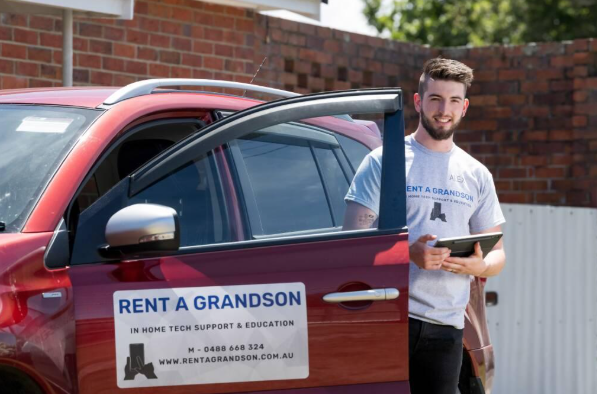
Alex Stephens has recently launched a small business called Rent a Grandson in Launceston. Picture by Phillip Biggs.
“The older generation didn’t have that luxury. It was brought into their life much later on.”
His neighbour Nancy Dear agrees, saying that she started using computers when she started work as a primary school teacher.
She’s been trying to keep up with new technology as it develops and says Alex has been “really marvellous.”
Her children and grandchildren live interstate or far away from her and there are others in similar situations without anyone to rely on, she said.
The biggest tech issues her generation face is having to do everything online, Mrs Dear said, whether that’s applying for Centrelink pensions, scanning documents or applying for other paperwork.
When people don’t have anyone to help them, their usual response is to “throw their hands up in horror and take no notice of it”.
Some of her friends even refuse to engage or answer messages because they have problems with phones and the internet, she said.
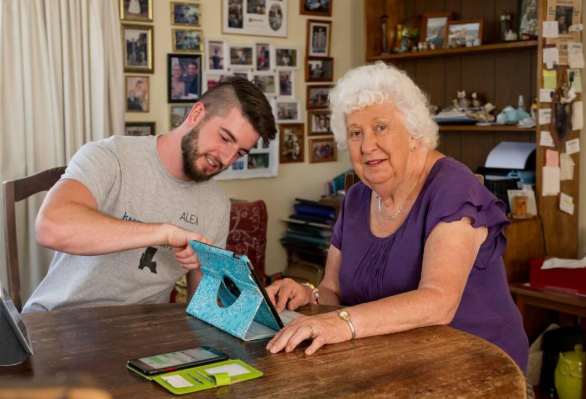
Alex teaching Nancy how to use a tablet. Picture by Phillip Biggs.
Alex is also concerned about the vulnerability of older people falling to scams which he says have become the biggest technological problem affecting older people and are becoming “more and more rife in the community.”
“So, last year, there [were] 13 million Australians who were exposed to scams in some way,” he said.
Falling victim to a scam can quickly clear out a bank account and someone’s life savings and can have a “really big impact,” he said.
“The knowing of how to use your device or browse online safely is a very important thing as well.”
It’s the kind of thing where a lot of people depend on their kids or grandkids to help them get savvy, but not something that everyone has the luxury of drawing on, he admits.
Both Nancy and Alex encourage those who are stubborn or feel stuck with technology to start learning.
COVID has shown how quickly technology can become an important and essential part of our lives, Alex says.
In 2018, 79 per cent of people who didn’t use the internet said they had no need or interest, he said.
But COVID quickly changed things. QR codes, which require smartphones became “a big thing” and technology became a way for people to stay connected with their loved ones.
A phone or video call became the only way to stay in touch, he said.
“The world’s definitely changing and just doing a little bit can drastically improve your quality of life as well.”